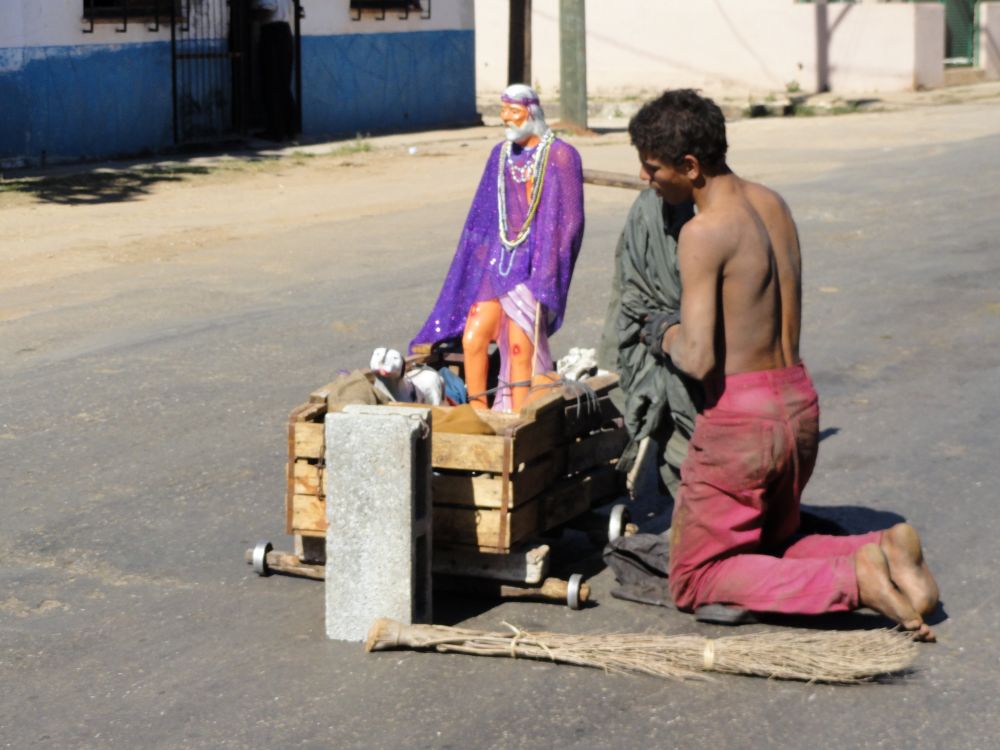
The Pilgrim & the Parable

The Pilgrim & the Parable: Every December 17th, the feast day of the Catholic Saint Lazarus, thousands of Cubans from all walks of life make a pilgrimage to the Rincón de San Lázaro, a former leper colony and shrine to the saint on the outskirts of Havana. Many do so on their knees while dressed in sack cloth and pushing a home-styled image of San Lázaro, as they beg for alms for the poor and seek redemption of their sins. Dressed in purple robes and accompanied by street dogs who lick his wounds, Cubans’ image of San Lázaro, also called Babaluayé in Cuba, originates in the parable told by Jesus about a man named Lazarus who suffered hunger and pain at the door of a rich man who ignored him all of his life. After both Lazarus and the rich man died, the latter found himself on the other side of a trench from where he could see Lazarus held tenderly in arms the great prophet Abraham. Parched with thirst, the now desperate rich man tries to convince Abraham to “send Lazarus” (as if he were still an inferior being and a servant) to get him some water. Abraham refuse. Then, the rich man asks if he can at least warn his brothers who continue to live just as he did, with selfishness and contempt for the poor. Abraham again refuses: they already have great advantages in life, including the choice to repent and care for the countless numbers who beg for relief from suffering at their door. Photographed by Roberto García Milián. Camino al Rincón, 17 December 2013.
Prayers for Healing


Prayers for Healing: Pilgrims transform the floor at the Shrine of San Lazarus into an extension of the altar for candles. Regularly lit as markers of prayer and expressions of faith in Catholic churches, these candles carry special significance on the day of Saint Lazarus: they signify a petition for help as well as the petitioner’s confidence in Saint Lazarus’s intercession on the side of the destitute, the despairing, and the poor. From 1961 to 1991, when atheism officially defined the Cuban state, thousands of Cubans nonetheless disavowed the potential for political retribution and made a pilgrimage to the “Rincón” of Saint Lazarus on his feast day of December 17th. With the adoption of state secularism, those numbers exploded, particularly in the age of President Obama, who chose the 17th of December 2014 to announce his radical shift of policy. For island believers, the message was clear: Obama, like Saint Lazarus, stood with the disempowered and poor. Photographed by Roberto García Milián. Camino al Rincón, 17 December 2013.
Articles of Faith


Articles of Faith: The sale of religious statues on the pilgrimage route to the Shrine of Saint Lazarus is symbolic of the striking economic and cultural openings that President Barack Obama’s policy of normalizing relations with Cuba created over the course of his administration. Mostly acquired by island sellers through business partners in Miami, the statues reflect a fusion or overlap among Roman Catholicism, local Cuban popular variants of the faith and Santería, a religion originated by Yoruba-speaking slaves in Nineteenth-Century Cuba. The Virgin of Charity, a Black image of Saint Lazarus, Saint Barbara and the Virgin of Regla are found next to mythical figures meant to invoke specific spiritual protectors through the guise of an Indian, a black child, even a bulldog. Photographed by Roberto García Milián. Camino al Rincón, 17 December 2013.